Thursday, February 25, 2016

Oldest movie in history

Roundhay Garden Scene is an 1888 short silent film recorded by French inventor Louis Le Prince. It is believed to be the oldest surviving film in existence, as noted by the Guinness Book of Records.

Overview
According to Le Prince's son, Adolphe, the film was made at Oakwood Grange, the home of Joseph and Sarah Whitley, in Roundhay, Leeds, West Riding of Yorkshire, on October 14, 1888.
It features Adolphe Le Prince, Sarah Whitley, Joseph Whitley and Annie Hartley in the garden, walking around. Note that Sarah is walking backwards as she turns around, and that Joseph's coat tails are flying as he also is turning. Joseph and Sarah Whitley were Adolph Le Prince's parents-in-law, being the parents of his wife, Elizabeth, and Annie Hartley, also known as Harriet Hartley, was a friend of Le Prince and his wife. Sarah Whitley died ten days after the scene was taken.

Remastered Footage
In 1930 the National Science Museum (NSM), London, produced photographic copies of surviving parts from the 1888 filmstrip. This sequence was recorded on an 1885 Eastman Kodak paper base photographic film through Le Prince's single-lens combi camera-projector. Le Prince's son, Adolphe, stated that the Roundhay Garden movie was shot at 12 frames/s (and a second movie, Traffic Crossing Leeds Bridge, at 20 frames/s), however the later digital remastered version of Roundhay Garden produced by the National Media Museum, Bradford, which contains 52 frames, runs at 24.64 frames/s, a modern cinematographic frame rate, so it plays in only 2.11 seconds. The National Science Museum copy has 20 frames; at 12 frames/s, this produces a run time of 1.66 seconds.

Monday, February 22, 2016

World luckiest man

Frane Selak (born 1929) is a Croatian music teacher who has escaped death seven times, and afterward won the lottery in 2003, prompting journalists to dub him "the world's luckiest man", and "world's luckiest unluckiest man".

Brushes with death
Selak's supposed brushes with death started in January 1962 when he was riding a train through a cold, rainy canyon and the train flipped off the tracks and crashed in a river. Someone pulled Selak to safety, while 17 other passengers drowned. Selak suffered a broken arm and hypothermia. The next year, during his first and only plane ride, he was blown out of a malfunctioning plane door and landed in a haystack; the plane crashed, killing 19 people. However, there is no report of any plane crash in Croatia in 1963. Three years after that, in 1966, a bus that he was riding skidded off the road and into a river, drowning four passengers. Selak swam to shore with a few cuts and bruises.[1]
In 1968 Selak was teaching his youngest son how to hold a gun when the safety trigger was accidentally off and Selak managed to shoot himself in one of his testicles. He was taken to hospital where the casing from the bullet was found, and his testicle had to be removed.
In 1970 his car caught fire as he was driving and he managed to escape before the fuel tank blew up. Three years later, in another driving incident, the engine of his car was doused with hot oil from a malfunctioning fuel pump, causing flames to shoot through the air vents. Selak's hair was completely singed in this incident, but he was otherwise unharmed. In 1995, he was struck by a bus in Zagreb, but sustained only minor injuries. In 1996 he eluded a head-on collision with a United Nations truck on a mountain curve by swerving into a guardrail, which gave way under the force of his car; he was ejected from the car when the door flew open (he wasn't wearing a seatbelt) and watched his car plummet down 90 metres (300 ft) into a gorge.
As of 2015, none of Selak's claims have been independently verified.
Lottery winner
In 2003, two days after his 73rd birthday, Selak won €800,000 (US$1,110,000) in the lottery. At the time of his win, he also married for the fifth time. While he purchased two houses and a boat with his winnings, in 2010 he decided to give most of the remaining money away to relatives and friends after deciding to live a frugal lifestyle.

Landing on moon, fake or not ?

1. The American Flag Flutters Gently in the Non Existent Breeze

It’s an iconic image for the citizens of the United States of America: their flag, planted on the moon and waving gently in the breeze. Only, there is no breeze on the moon, meaning there is no air in the moon’s atmosphere, and hence, there is no wind whatsoever. This is one of the most obvious stuff ups in the staged moon landing hoax. Of course, NASA tries to get around this by saying it wasn’t blowing in the wind, it was just a bit crumpled from being rolled up on the journey…Well, judge for yourself.


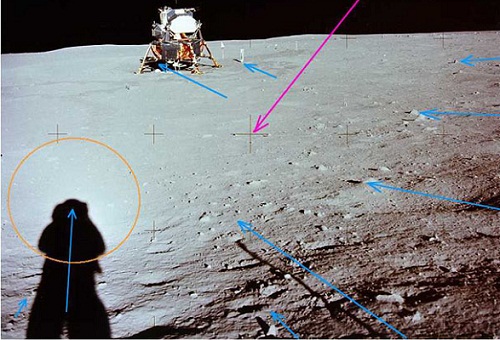
2. Is There More Than One Sun? Because Those Shadows Don’t Match Up!

NASA produced an abundant supply of photos and video footage to support their moon landing. But, it soon became evident that there was something a bit fishy about these photos on the moon; ever noticed that the angle of the shadows do not match up? Shadows are caused by light sources. On the moon, there should only be one light source: the Sun. So, logically, all shadows should be parallel to each other. Only shadows in the photos of moon landing are not. In fact, the shadows in many of the photos run in different directions. It’s almost as if the shadows are caused by… yes, multiple lights on a film set!


3. You’re in Space… Then Where Are the Stars?

On a cloudless evening, you can see an abundance of twinkling stars in the night sky. Surely from the moon, with its lack of clouds and complete absence of artificial light, you should be able to see even more stars with the naked eye? Only, you can’t. In fact, in all of the photos taken during moon landing, you cannot see a single star. Not one. Sure, the photos taken in the 60’s weren’t amazing quality, but these days you can capture the stars in a photo taken from your phone, so shouldn’t the high tech NASA cameras have been able to pick up something?


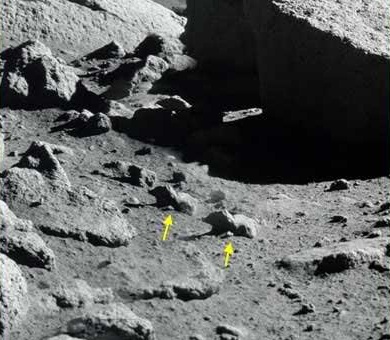
4. Oh Look! Same Rocks & Mountains…Again…And Again

NASA has marked out the exact locations of the moon landing missions, showing how they have explored sites that are miles apart. With that in mind, why do the photos from the Apollo 15 mission show identical backdrops? NASA swears that these photos were taken in different locations, yet the photographic evidence clearly shows the same patterns of gently sloping hills and valleys. It’s almost like NASA were just getting sloppy by the time they hit the Apollo 15 mission. “Why bother creating new sets, we’ll just use the same ones repeatedly…Surely no one will notice.”


5. Carved by Nature… Why Does That Rock Have a "C" Drawn on It?

In yet another example of the technicians on set just being sloppy, one of the moon landing photos shows a “moon rock” which has a perfect letter ‘C’ printed on it. The perfect symmetry of the letter shows that it is not naturally occurring. Now, it’s perfectly credible that a prop used on a film set would be marked with a reference letter. But there is no plausible argument for the “C” just being naturally weathered into the surface of the rock. As a result, NASA came up with a different, though no less implausible, explanation for the rock with the “C”. According to them, it’s a stray hair. It can’t be more ridiculous than this!


6. Fly Through a Belt of Radiation and You Should've Get Cooked

Everyone knows how dangerous radiation can be: overexposure to it can cause radiation poisoning and even death, so It is should be avoided at all costs. To get to the moon, you have to fly through a band a radiation known as the Van Allen radiation belt. Yes, the space craft had an aluminum coating, but is that really enough to protect a human being whilst they spend over one and a half hours traversing a band of radiation? NASA, of course, said “yes” and that the astronauts weren’t in the radiation for all that long. But an hour and a half still sounds like a pretty long time to be inside a cosmic microwave.


7. What’s That I Can See Reflected in Your Helmet?

When the photos were published of the Apollo 12 moon landing, many people noticed something a tad unusual reflected in the shiny helmet of an astronaut. It appeared to be something hanging from a wire or perhaps a rope. In fact, it looked suspiciously like an overhead spotlight, the kind you see used in Hollywood movie studios. Whilst admittedly, the photo quality is a bit grainy, making it impossible to positively identify the object. It still begs the question: what could possibly be suspended in midair on the moon? There should be nothing there for anything to be hanging from!

8. Not Much of an Impact

Have you ever seen the photos of the astronauts footprints embedded in moon dust? The astronauts described this dust as being similar to “talcum powder or wet sand”. That being the case, why is there no sign of impact where the lunar module landed? You’d think that a rocket-ship landing on a big pile of talcum powder would leave some kind of impression in the surface, but according to the moon landing photos, no such evidence exists. In fact, it looks more like the lunar module was just placed in position. This is just yet another blindingly obvious defect in the details of the moon landing hoax.

Sunday, February 21, 2016

Suez Canal

The Suez Canal is an artificial sea-level waterway in Egypt, connecting the Mediterranean Sea to the Red Sea through the Isthmus of Suez, and separates the African continent from Asia. After 10 years of construction, it was officially opened on November 17, 1869. The canal allows ships to travel between Europe and South Asia without navigating around Africa, thereby reducing the sea voyage distance by about 7,000 kilometres (4,300 mi). It extends from the northern terminus of Port Said to the southern terminus of Port Tewfik at the city of Suez. Its length is 193.30 km (120.11 mi), including its northern and southern access channels. In 2012, 17,225 vessels traversed the canal (47 per day).[1]
The canal is a single-lane waterway with passing locations in the Ballah Bypass and the Great Bitter Lake. It contains no locks system, with seawater flowing freely through it. In general, the canal north of the Bitter Lakes flows north in winter and south in summer. South of the lakes, the current changes with the tide at Suez.
The canal is owned and maintained by the Suez Canal Authority (SCA) of Egypt. Under the Convention of Constantinople, it may be used "in time of war as in time of peace, by every vessel of commerce or of war, without distinction of flag."
In August 2014, construction was launched to expand and widen the Ballah Bypass for 35 km (22 mi) to speed the canal's transit time. The expansion is expected to double the capacity of the Suez Canal from 49 to 97 ships a day. At a cost of $8.4 billion, this project was funded with interest-bearing investment certificates issued exclusively to Egyptian entities and individuals. The "New Suez Canal", as the expansion was dubbed, was opened with great fanfare in a ceremony on 6 August 2015.

Panama Canal

The Panamá Canal is a 48-mile (77 km) ship canal in Panama that connects the Atlantic Ocean (via the Caribbean Sea) to the Pacific Ocean. The canal cuts across the Isthmus of Panama and is a key conduit for international maritime trade. There are locks at each end to lift ships up to Gatun Lake, an artificial lake created to reduce the amount of excavation work required for the canal, 26 metres (85 ft) above sea level. The current locks are 33.5 metres (110 ft) wide. A third, wider lane of locks is currently under construction and is due to open in April of 2016.
France began work on the canal in 1881, but had to stop because of engineering problems and high mortality due to disease. The United States took over the project in 1904, and took a decade to complete the canal, which was officially opened on August 15, 1914. One of the largest and most difficult engineering projects ever undertaken, the Panama Canal shortcut greatly reduced the time for ships to travel between the Atlantic and Pacific Oceans, enabling them to avoid the lengthy, hazardous Cape Horn route around the southernmost tip of South America via the Drake Passage or Strait of Magellan. The shorter, faster, and safer route to the U.S. West Coast and to nations in and around the Pacific Ocean allowed those places to become more integrated with the world economy.
During construction, ownership of the territory that the Panama Canal now passes through was first Colombian, then French, and then American. The US continued to control the canal and surrounding Panama Canal Zone until the 1977 Torrijos–Carter Treaties provided for handover to Panama. After a period of joint American–Panamanian control, the canal was taken over by the Panamanian government in 1999, and is now managed and operated by the Panama Canal Authority, a Panamanian government agency.
Annual traffic has risen from about 1,000 ships in 1914, when the canal opened, to 14,702 vessels in 2008, the latter measuring a total of 309.6 million Panama Canal/Universal Measurement System (PC/UMS) tons. By 2008, more than 815,000 vessels had passed through the canal; the largest ships that can transit the canal today are called Panamax. It takes 6 to 8 hours to pass through the Panama Canal. The American Society of Civil Engineers has named the Panama Canal one of the seven wonders of the modern world.

Largest cities in the world ranked by population

Have you ever wondered which cities are with largest population ?
Here you can see:

1. Tokyo - capital of Japan and biggest city in the world. population is 33.200.000


2. New York Metro - best city in United States of America, population is 17.800.000


3. Sao Paulo - biggest city in Brasil, population is 17.700.000


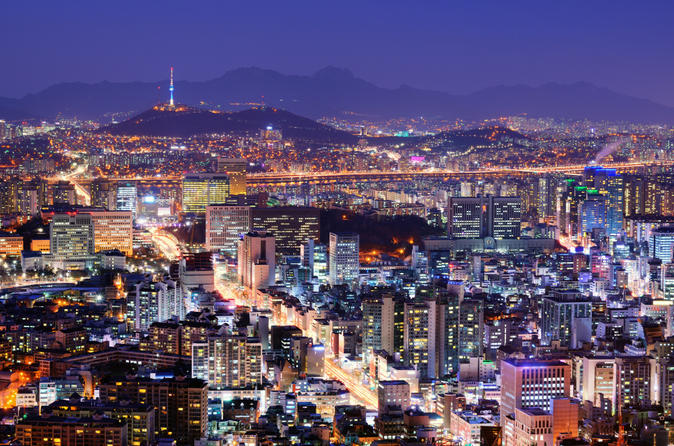
4. Seoul - Capital of South Korea, population is 17.500.000


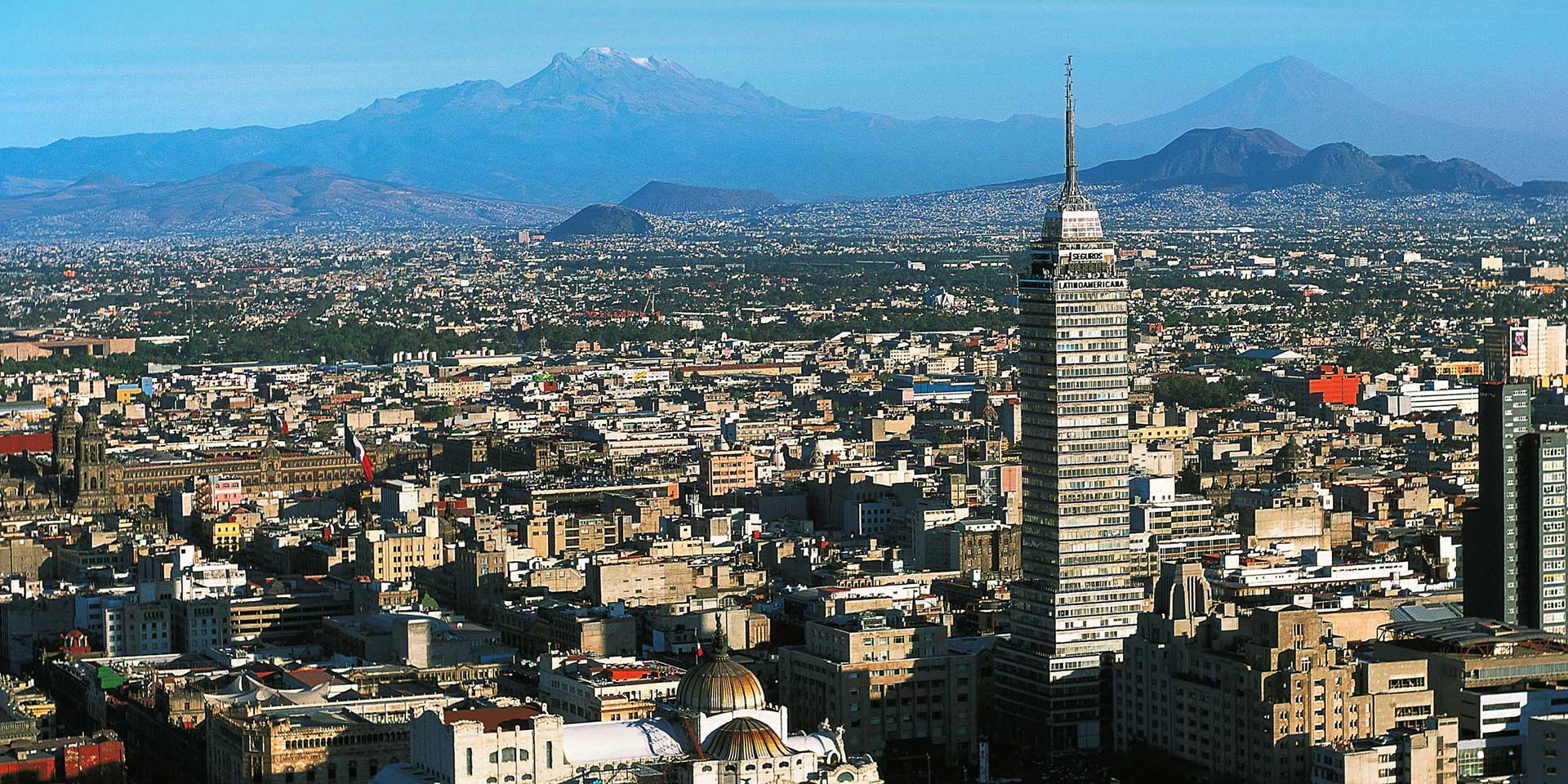
5. Mexico City - Capital of Mexico, population is 17.400.000
Add caption

Wednesday, February 17, 2016

How chocolate affects satisfaction

Serotonin or hormone of happiness and satisfaction, as people call it, secrete of the adrenal gland and is preceded by adrenaline. How emphasizes Dr. Bokun, without it there is no joy of heart, euphoria and life. At the mention of this neurotransmitter, one of the first associations is chocolate. It supposedly increases the level of serotonin, and made us satisfied and happy. According to some research actually chocolate contains substances that are a good substitute for this hormone. In addition to chocolate, you can enlarge the level of serotonin in your body with carbohidrates. Within thirty minutes after you have eaten, such as pasta, starchy vegetables, cereal or whole grain bread, you will feel calm and relaxed.


Comments system

Disqus Shortname