Sunday, March 6, 2016

Bali

Bali is an island and province of Indonesia. The province includes the island of Bali and a few smaller neighbouring islands, notably Nusa Penida, Nusa Lembongan, and Nusa Ceningan. It is located at the westernmost end of the Lesser Sunda Islands, between Java to the west and Lombok to the east. Its capital of Denpasar is located at the southern part of the island.

With a population of 3,890,757 in the 2010 census, and 4,225,000 as of January 2014, the island is home to most of Indonesia's Hindu minority. According to the 2010 Census, 83.5% of Bali's population adhered to Balinese Hinduism, followed by 13.4% Muslim, Christianity at 2.5%, and Buddhism 0.5%.

Bali is a popular tourist destination, which has seen a significant rise in tourists since the 1980s. It is renowned for its highly developed arts, including traditional and modern dance, sculpture, painting, leather, metalworking, and music. The Indonesian International Film Festival is held every year in Bali.

Bali is part of the Coral Triangle, the area with the highest biodiversity of marine species. In this area alone over 500 reef building coral species can be found. For comparison, this is about 7 times as many as in the entire Caribbean. There is a wide range of dive sites with high quality reefs, all with their own specific attractions. Many sites can have strong currents and swell, so diving without a knowledgeable guide is inadvisable. Most recently, Bali was the host of the 2011 ASEAN Summit, 2013 APEC and Miss World 2013.

The island of Bali lies 3.2 km (2 mi) east of Java, and is approximately 8 degrees south of the equator. Bali and Java are separated by the Bali Strait. East to west, the island is approximately 153 km (95 mi) wide and spans approximately 112 km (69 mi) north to south; administratively it covers 5,780 km2, or 5,577 km2 without Nusa Penida District, its population density is roughly 750 people/km2.

Bali's central mountains include several peaks over 3,000 metres (9,800 feet) in elevation. The highest is Mount Agung (3,031 m (9,944 ft)), known as the "mother mountain" which is an active volcano rated as one of the world's most likely sites for a massive eruption within the next 100 years. Mountains range from centre to the eastern side, with Mount Agung the easternmost peak. Bali's volcanic nature has contributed to its exceptional fertility and its tall mountain ranges provide the high rainfall that supports the highly productive agriculture sector. South of the mountains is a broad, steadily descending area where most of Bali's large rice crop is grown. The northern side of the mountains slopes more steeply to the sea and is the main coffee producing area of the island, along with rice, vegetables and cattle. The longest river, Ayung River, flows approximately 75 km.

The island is surrounded by coral reefs. Beaches in the south tend to have white sand while those in the north and west have black sand. Bali has no major waterways, although the Ho River is navigable by small sampan boats. Black sand beaches between Pasut and Klatingdukuh are being developed for tourism, but apart from the seaside temple of Tanah Lot, they are not yet used for significant tourism.


Subak irrigation system
The largest city is the provincial capital, Denpasar, near the southern coast. Its population is around 491,500 (2002). Bali's second-largest city is the old colonial capital, Singaraja, which is located on the north coast and is home to around 100,000 people. Other important cities include the beach resort, Kuta, which is practically part of Denpasar's urban area, and Ubud, situated at the north of Denpasar, is the island's cultural centre.

Three small islands lie to the immediate south east and all are administratively part of the Klungkung regency of Bali: Nusa Penida, Nusa Lembongan and Nusa Ceningan. These islands are separated from Bali by the Badung Strait.

To the east, the Lombok Strait separates Bali from Lombok and marks the biogeographical division between the fauna of the Indomalayan ecozone and the distinctly different fauna of Australasia. The transition is known as the Wallace Line, named after Alfred Russel Wallace, who first proposed a transition zone between these two major biomes. When sea levels dropped during the Pleistocene ice age, Bali was connected to Java and Sumatra and to the mainland of Asia and shared the Asian fauna, but the deep water of the Lombok Strait continued to keep Lombok Island and the Lesser Sunda archipelago isolated.

Saturday, March 5, 2016

Kalahari Desert

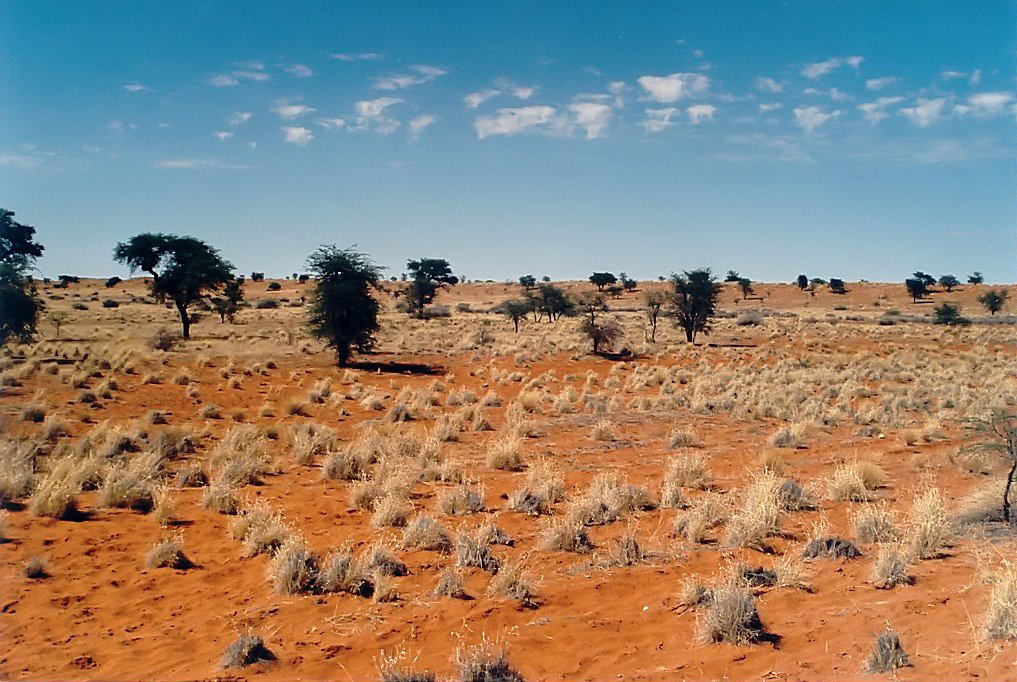
The Kalahari Desert (in Afrikaans: Kalahari-woestyn) is a large semi-arid sandy savannah in southern Africa extending 900,000 square kilometres (350,000 sq mi), covering much of Botswana, parts of Namibia, and regions of South Africa. A semi-desert, with huge tracts of excellent grazing after good rains, the Kalahari supports more animals and plants than a true desert, such as the Namib Desert to the west. There are small amounts of rainfall and the summer temperature is very high. The driest areas usually receive 110–200 millimetres of rain per year, and the wettest just a little over 500 millimetres (20 in). The surrounding Kalahari Basin covers over 2,500,000 square kilometres (970,000 sq mi) extending farther into Botswana, Namibia and South Africa, and encroaching into parts of Angola, Zambia and Zimbabwe. The Kalahari is home to many migratory birds and animals. Previously havens for wild animals from elephants to giraffes, and for predators such as lions and cheetahs, the riverbeds are now mostly grazing spots, though leopards and cheetahs can still be found. The area is now heavily grazed and cattle fences restrict the movement of wildlife. Among deserts of the Southern Hemisphere, the Kalahari most closely resembles some Australian deserts in its latitude and its mode of formation. The Kalahari Desert came into existence approximately sixty million years ago along with the formation of the African continent.

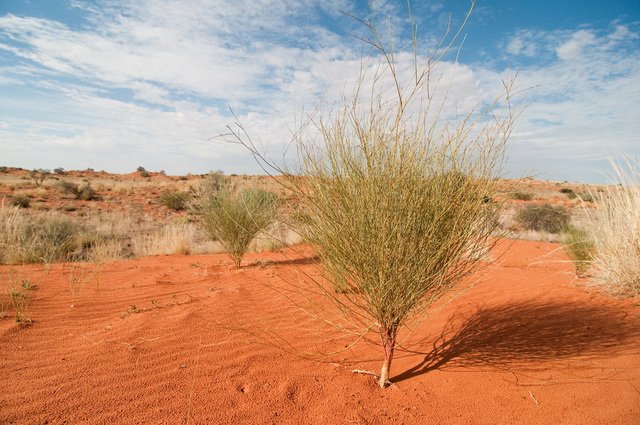
Derived from the Tswana word Kgala, meaning "the great thirst", or Kgalagadi, meaning "a waterless place", the Kalahari has vast areas covered by red sand without any permanent surface water. Drainage is by dry valleys, seasonally inundated pans, and the large salt pans of the Makgadikgadi Pan in Botswana and Etosha Pan in Namibia. The only permanent river, the Okavango, flows into a delta in the northwest, forming marshes that are rich in wildlife. Ancient dry riverbeds—called omuramba—traverse the central northern reaches of the Kalahari and provide standing pools of water during the rainy season.

Despite its aridity, the Kalahari supports a variety of flora. The native flora includes acacia trees and many other herbs and grasses. The kiwano fruit, also known as the horned melon, melano, African horned cucumber, jelly melon, or hedged gourd, is endemic to a region in the Kalahari Desert (specific region unknown).

Even where the Kalahari "desert" is dry enough to qualify as a desert in the sense of having low precipitation, it is not strictly speaking a desert because it has too dense a ground cover. The main region that lacks ground cover is in the southwest Kalahari (southeast of Namibia, northwest of South Africa and southwest of Botswana) in the south of the Kgalagadi Transfrontier Park. For instance in the ZF Mgcawu District Municipality of South Africa, total vegetation cover may be as low as 30.72% on non-protected (from cattle grazing) farmlands south of Twee Rivieren Rest Camp and 37.74% in the protected (from cattle grazing) South African side of the Kgalagadi Transfrontier Park: these southernmost Kalahari xeric savanna areas are truly semi-deserts. However, in all the remaining Kalahari, except on salt pans during the dry season, the vegetation cover can be clearly denser, up to almost 100% in some limited areas.

In an area of about 600,000 km2 in the south and west of the Kalahari, the vegetation is mainly xeric savanna. This area is the ecoregion identified by World Wide Fund for Nature as Kalahari xeric savanna. Typical savanna grasses include (Schmidtia, Stipagrostis, Aristida, and Eragrostis) interspersed with trees such as camelthorn (Acacia erioloba), grey camelthorn (Acacia haematoxylon), shepherd’s tree (Boscia albitrunca), blackthorn (Acacia mellifera), and silver cluster-leaf (Terminalia sericea).

In certain areas where the climate is drier, it becomes a true semi-desert with ground not entirely covered by vegetation: "open" as opposed to "closed" vegetation. Examples include the north of the Siyanda District, itself in the north of South Africa, and the Keetmanshoop Rural in the southeast of Namibia. In the north and east, there are dry forests covering an area of over 300,000 km2 in which Rhodesian teak and several species of acaciaare prominent.

Outside the Kalahari "desert", but in the Kalahari basin, a halophytic vegetation to the north is adapted to pans, lakes that are completely dry during the dry season, and maybe for years during droughts, such as in Etosha and Makgadikgadi

A totally different vegetation is adapted to the perennial fresh water of the Okavango Delta, an ecoregion termed.

Friday, March 4, 2016

Most profitable programming languages

1.    SQL
It’s no surprise SQL (pronounced ‘sequel’) tops the job list since it can be found far and wide in various flavors. Database technologies such as MySQL, PostgreSQL and Microsoft SQL Server power big businesses, small businesses, hospitals, banks, universities. Indeed, just about every computer and person with access to technology eventually touches something SQL. For instance, all Android phones and iPhones have access to a SQL database called SQLite and many mobile apps developed Google, Skype and DropBox use it directly.
2.    Java
The tech community recently celebrated the 20th anniversary of Java. It’s one of the most widely adopted programming languages, used by some 9 million developers and running on 7 billion devices worldwide. It’s also the programming language used to develop all native Android apps. Java’s popularity with developers is due to the fact that the language is grounded in readability and simplicity. Java has staying power since it has long-term compatibility, which makes sure older applications continue to work now into the future. It’s not going anywhere anytime soon and is used to power company websites like LinkedIn.com, Netflix.com and Amazon.com.
3.    JavaScript
JavaScript – not to be confused with Java – is another one of the world’s most popular and powerful programming languages, and is used to spice up web pages by making them interactive. For example, JavaScript can be used to add effects to web pages, display pop-up messages or to create games with basic functionality. It’s also worth noting that JavaScript is the scripting language of the World Wide Web and is built right into all major web browsers including Internet Explorer, FireFox and Safari. Almost every website incorporates some element of JavaScript to add to the user experience, adding to the demand for JavaScript developers. In recent years JavaScript has also gained use as the foundation of Node.js, a server technology that among other things enables real-time communication.  
4.    C#
Dating from 2000, C# (pronounced C-sharp) is a relatively new programming language designed by Microsoft for a wide range of enterprise applications that run on the .NET Framework. An evolution of C and  C++, the C# language is simple, modern, type safe and object oriented.
5.    C++
C++ (pronounced C-plus-plus) is a general purpose object-oriented programming language based on the earlier ‘C’ language. Developed by Bjarne Stroustrup at Bell Labs, C++ was first released in 1983. Stroustrup keeps an extensive list of applications written in C++. The list includes Adobe and Microsoft applications, MongoDB databases, large portions of Mac OS/X and is the best language to learn for performance-critical applications such as “twitch” game development or audio/video processing.
6.    Python
Python is a general purpose programming language that was named after the Monty Python (so you know it’s fun to work with)! Python is simple and incredibly readable since closely resembles the English language. It’s a great language for beginners, all the way up to seasoned professionals. Python recently bumped Java as the language of choice inintroductory programming courses with eight of the top 10 computer science departments now using Python to teach coding, as well as 27 of the top 39 schools. Because of Python’s use in the educational realm, there are a lot of libraries created for Python related to mathematics, physics and natural processing. PBS, NASA and Reddit use Python for their websites.
7.     PHP
Created by Danish-Canadian programmer Rasmus Lerdorf in 1994, PHP was never actually intended to be a new programming language. Instead, it was created to be a set of tools to help Rasmus maintain his Personal Home Page (PHP). Today, PHP (Hypertext Pre-Processor) is a scripting language, running on the server, which can be used to create web pages written in HTML. PHP tends to be a popular languages since its easy-to use by new programmers, but also offers tons of advanced features for more experienced programmers.9.   
8.    iOS/Swift
In 2014, Apple decided to invent their own programming language. The result was Swift – a new programming language for iOS and OS X developers to create their next killer app. Developers will find that many parts of Swift are familiar from their experience of developing in C++ and Objective-C. Companies including American Airlines, LinkedIn, and Duolingo have been quick to adopt Swift, and we’ll see this language on the rise in the coming years.
Any great craftsman has a belt full of tools, each a perfect choice for certain situations. Similarly, there will never be just a single programming language, and each language will evolve and improve over time to keep pace with innovation.
9.    Ruby on Rails
Like Java or the C language, Ruby is a general purpose programming language, though it is best known for its use in web programming, and Rails serves as a framework for the Ruby Language. Ruby on Rails has many positive qualities including rapid development, you don’t need as much code, and there are a wide variety of 3rd party libraries available. It’s used from companies ranging from small start-ups to large enterprises and everything in-between. Hulu, Twitter, Github and Living Social are using Ruby on Rails for at least one of their web applications.


Komodo dragon

The Komodo dragon, also known as the Komodo monitor, is a large species of lizard found in the Indonesian islands of Komodo, Rinca, Flores, Gili Motang, and Padar. A member of the monitor lizard family Varanidae, it is the largest living species of lizard, growing to a maximum length of 3 metres (10 ft) in rare cases and weighing up to approximately 70 kilograms (150 lb). Their unusually large size has been attributed to island gigantism, since no other carnivorous animals fill the niche on the islands where they live. However, recent research suggests the large size of Komodo dragons may be better understood as representative of a relict population of very large varanid lizards that once lived across Indonesia and Australia, most of which, along with other megafauna, died out after the Pleistocene. Fossils very similar to V. komodoensis have been found in Australia dating to greater than 3.8 million years ago, and its body size remained stable on Flores, one of the handful of Indonesian islands where it is currently found, over the last 900,000 years, "a time marked by major faunal turnovers, extinction of the island's megafauna, and the arrival of early hominids by 880 ka ." As a result of their size, these lizards dominate the ecosystems in which they live. Komodo dragons hunt and ambush prey including invertebrates, birds, and mammals. It has been claimed that they have a venomous bite; there are two glands in the lower jaw which secrete several toxic proteins. The biological significance of these proteins is disputed, but the glands have been shown to secrete an anticoagulant. Komodo dragon group behaviour in hunting is exceptional in the reptile world. The diet of big Komodo dragons mainly consists of deer, though they also eat considerable amounts of carrion. Komodo dragons also occasionally attack humans in the area of West Manggarai Regency where they live in Indonesia. Mating begins between May and August, and the eggs are laid in September. About 20 eggs are deposited in abandoned megapode nests or in a self-dug nesting hole. The eggs are incubated for seven to eight months, hatching in April, when insects are most plentiful. Young Komodo dragons are vulnerable and therefore dwell in trees, safe from predators and cannibalistic adults. They take 8 to 9 years to mature, and are estimated to live up to 30 years. Komodo dragons were first recorded by Western scientists in 1910. Their large size and fearsome reputation make them popular zoo exhibits. In the wild, their range has contracted due to human activities, and they are listed as vulnerable by the IUCN. They are protected under Indonesian law, and a national park, Komodo National Park, was founded to aid protection efforts.


Sunday, February 28, 2016

Kepler 186f

Kepler-186f is an exoplanet orbiting the red dwarf Kepler-186, about 490 light-years (151 pc) from the Earth. It is the first planet with a radius similar to Earth's to be discovered in the habitable zone of another star. NASA's Kepler spacecraft detected it using the transit method, along with four additional planets orbiting much closer to the star (all modestly larger than Earth). Analysis of three years of data was required to find its signal. The results were presented initially at a conference on 19 March 2014 and some details were reported in the media at the time. The public announcement was on 17 April 2014, followed by publication in Science.

The only physical property directly derivable from the observations (besides the orbital period) is the ratio of the radius of the planet to that of the central star, which follows from the amount of occultation of stellar light during a transit. This ratio was measured to be 0.021. This yields a planetary radius of 1.11±0.14 times that of Earth, taking into account uncertainty in the star's diameter and the degree of occultation. Thus, the planet is about 11% larger in radius than Earth (between 4.5% smaller and 26.5% larger), giving a volume about 1.37 times that of Earth (between 0.87 and 2.03 times as large).

There is a very wide range of possible masses that can be calculated by combining the radius with densities derived from the possible types of matter that planets can be made from; it could be a rocky terrestrial planet or a lower density ocean planet with a thick atmosphere. However, a massive hydrogen/helium (H/He) atmosphere is thought to be unlikely in a planet with a radius below 1.5 R. Planets with radii of more than 1.5 times that of Earth tend to accumulate the thick atmospheres that would make them less likely to be habitable. Red dwarfs emit a much stronger extreme ultraviolet (XUV) flux when young than later in life; the planet's primordial atmosphere would have been subjected to elevated photoevaporation during that period, which would probably have largely removed any H/He-rich envelope through hydrodynamic mass loss. Mass estimates range from 0.32 M for a pure water/ice composition to 3.77 M if made up entirely of iron (both implausible extremes). For a body with radius 1.11 R, a composition similar to Earth’s (1/3 iron, 2/3 silicate rock) yields a mass of 1.44 M, taking into account the higher density due to the higher average pressure compared to Earth. Kepler-186f has an Earth Similarity Index (ESI) of 0.64.


Macau

Macau, also spelled Macao, officially known as the Macao Special Administrative Region of the People's Republic of China, is a special administrative region on the southern coast of the People's Republic of China. Macau lies on the western side of the Pearl River Delta across from Hong Kong, which is about 64 kilometers to the east, and it is also bordered by Guangdong of Mainland China to the north and the South China Sea to the east and south. With an estimated population of around 636,200 living in an area of 30.3 km2 (11.6 sq mi), it is the most densely populated region in the world.

As Portuguese Macau, it was administered by the Portuguese Empire and its inheritor states from the mid-16th century until late 1999, when it was the last remaining European colony in Asia under Portugal. Portuguese traders first settled in Macau in the 1550s. In 1557, Macau was rented to Portugal from Ming China as a trading port. The Portuguese Empire administered the city under Chinese authority and sovereignty until 1887, when Macau became a colony. Sovereignty over Macau was transferred to China on 20 December 1999. The Joint Declaration on the Question of Macau and Macau Basic Law stipulate that Macau operate with a high degree of autonomy until at least 2049, fifty years after the transfer.

Under the policy of "one country, two systems", the State Council of the People's Republic of China is responsible for military defense and foreign affairs while Macau maintains its own legal system, the public security force, monetary system, customs policy, and immigration policy. Macau participates in many international organizations and events that do not require members to possess national sovereignty.

Macau is one of the world's richest cities, and as of 2013 its GDP per capita by purchasing power parity is higher than that of any country in the world, according to the World Bank. It became the world's largest gambling centre in 2006, with the economy heavily dependent on gambling and tourism, as well as manufacturing. Cantonese people from Hong Kong and Guangdong, in addition to the recent mainland tourism from Mandarin-speaking regions, have boosted the economy of Macau significantly. According to The World Factbook, Macau has the fourth highest life expectancy in the world. Moreover, it is one of only a few regions in Asia with a "very high Human Development Index", ranking 14th as of 2013.


Friday, February 26, 2016

Tutankhamun's mask

Tutankhamun's mask, also known as the funerary mask of Tutankhamun, is the death mask of the Ancient Egyptian pharaoh, Tutankhamun (reigned 1332–1323 BC). It was discovered by Howard Carter in 1925 in tomb KV62, and is now housed in the Egyptian Museum in Cairo. The mask is one of the most well known works of art in the world. According to the Egyptologist Nicholas Reeves, it is "not only the quintessential image from Tutankhamun's tomb, it is perhaps the best-known object from ancient Egypt itself". Since 2001, research has suggested that the mask may originally have been intended for Queen Neferneferuaten; her royal name (Ankhkheperure) was found in a partly erased cartouche on Tutankhamun's funerary mask.

The mask is 54 cm (21 in) tall, 39.3 cm (15.5 in) wide and 49 cm (19 in) deep. It is fashioned from two layers of high-karat gold, varying from 1.5–3 mm (0.059–0.118 in) in thickness, and weighing 10.23 kg (22.6 lb). X-ray crystallography has revealed that the mask contains two alloys of gold: a lighter 18.4 karat shade for the face and neck, and 22.5 karat gold for the rest of the mask.

The face represents the pharaoh's standard image, and the same image was found by excavators elsewhere in the tomb, in particular in the guardian statues. He wears a nemes headcloth, topped by the royal insignia of a cobra (Wadjet) and vulture (Nekhbet), symbolising Tutankhamun's rule of both Upper and Lower Egypt. The ears are pierced to hold earrings, a feature that appears to have been reserved for queens and children in almost all surviving ancient Egyptian works of art.

It contains inlays of coloured glass and gemstones, including lapis lazuli (the eye surrounds and eyebrows), quartz (the eyes), obsidian (the pupils), carnelian, feldspar, turquoise, amazonite, faience and other stones (as inlays of the broad collar).


Comments system

Disqus Shortname